
'Sebi has to make sure that investor interests are protected and at the same time, there isn't over-regulation so that companies don't get discouraged to list here.'

Both indices are down nearly 9 per cent from their all-time highs in mid-January. A sharp reversal seems difficult this time as the peak impact of the virus is yet to play out.

This follows a staggering inflow of Rs 19,967 cr in equities and debt last month
The move will increase working capital requirement for brokers, raise the work load on the system and will leave little room for contingencies.

In the context of market integrity, the IRAI and RBI should go over the minutes of the LIC and SBI board meetings when the decisions to invest in Adani equity or debt were taken, notes Jaimini Bhagwati, former World Bank treasury professional.

The price of bitcoin, the bestselling cryptocurrency, has shrunk nearly three times this year to mark the fate of such digital assets. Crashing prices, regulatory uncertainty and taxes have put Indian crypto exchanges in troubled waters. Finance Minister Nirmala Sitharaman's budget for FY23 announced a 30 per cent tax on any income from the transfer of virtual digital assets.

Last year's Budget had created uncertainty about the quantum of tax to be withheld on dividends paid to non-residents, as the exact tax rate was not specified under section 195.

Mutual funds (MFs) are set to be net sellers of Indian equities for the first time in the past seven financial years, having sold stocks worth about Rs 1.27 trillion so far in 2020-21 (FY21), making it the highest net sales on record in a financial year. MFs had been net buyers in the previous six financial years, including purchases of over Rs 1.41 trillion in FY18, Rs 88,152 crore in FY19, and Rs 91,814 crore in FY20. The last time they offloaded Indian equities was in FY14, when they net sold stocks worth Rs 21,159 crore. In contrast, foreign portfolio investors (FPIs) have ramped up buying in FY21, purchasing more than Rs 2.6 trillion worth of shares.

Providers write to Sebi, FinMin; launches may hit pause.

Although the RBI's open market operations have ensured sufficient system-level liquidity, some sectors are finding liquidity to be a challenge owing to their credit profile.

'If credit is not available, people will postpone buying. That's what has happened.'

The currency market won't care for our moans, groans, cries and sighs. The rupee will find its own level, explains Tamal Bandyopadhyay.


Education inflation abroad is high and the depreciation of the rupee can also set you back, says Vishal Dhawan

The widening of the CAD on a year-on-year basis was primarily on account of a higher trade deficit at $50 billion

A two-year extension at the helm of the RBI still looks a real possibility

The rupee closed at Rs 66.21 in its last trading session.

Retail inflation rose 4.38 per cent year-on-year in November, the slowest pace in data going back to January 2012.

If foreigners need reasonable taxes, why offer citizens something else? If foreign businessmen look for assurance on the rule of law, so do citizens, argues T N Ninan.

With the markets scaling new highs, as many as 43 stocks from the Nifty50 index and 27 of the 30 scrips that are part of the S&P BSE Sensex are trading above their respective 200-day moving average (DMA). The 200-DMA is seen as one of the most relevant trend indicators by investors and traders, who believe that stocks and indices trading above this level possess strength and are likely to rally in the short to medium term, while the ones trading below this level are viewed as bearish and expected to see a sell-off. Wipro, UPL, Kotak Mahindra Bank, Hindalco, Infosys, Cipla, and Adani Enterprises are the only stocks from the Nifty50 pack that are still below their respective 200-DMA, the exchange data suggests.

Likening India to the "cleanest among the dirty shirts" left with a person towards the end of a business visit, a foreign fund house said the country presents enormous growth potential despite the "kind of mess" it has been in for many years.

The Survey also said that the borrowings by banks have increased significantly.

When you buy a stock, especially a mid- and small-cap one, have a price target. Once you hit the target, exit the stock, advises Joydeep Ghosh.

The failure of SVB was due to idiosyncratic reasons, but shows how higher rates can expose fault lines in unforeseen places, observes Neelkanth Mishra.

Foreign investors, according to them, will now wait-and-watch how the economy takes shape in the backdrop of doubts over monsoon, interest rate trajectory and other global events such as the US - China trade war.

The NSE Nifty settled at 10,234.65, down 225.45 points, or 2.16 per cent.

Institutional investors led by foreign portfolio investors have bought these shares.

According to experts, work from home, volatility in stock markets worldwide, and redemption pressures compelled investors to defer new investment plans.
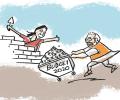
The Budget has relaxed a few safe harbour rules that aim to make it easier for fund managers overseeing offshore India-focused funds to relocate to the country.

The RBI holds its next policy meeting in early June.

While three of the top five FPIs - Capital, Government of Singapore, and Vanguard - have seen their investment value more than triple, India's benchmark indices have risen just 70%.

The central government's deposits with the RBI had fallen to just Rs 100 crore as of June 8.

Yes Bank topped the gainers' list on the Sensex. It was followed by HDFC, Bajaj Finance, HDFC Bank, ICICI Bank, L&T, SBI, Axis Bank and Kotak Bank -- rallying up to 5.24 per cent.

'The Indian market has all the factors at the moment: Over-valuation, over-confidence, reliance on some source of massive fund flows and massive scams.' 'The trigger for a collapse could also have arrived.' warns Devangshu Datta.

A complex holding structure and unrelated businesses clubbed under one roof could have been the reasons that prompted investors to shun the stock, experts say. These are likely to impact the company's ability to raise funds, too, they add.

India's stock exchanges have decided to jointly introduce the T+1 settlement cycle in phases from February 25, beginning with the bottom 100 stocks by market capitalisation. From March 2022, on the last Friday (or the immediate next trading day) of every month, the next 500 stocks from the bottom will be subject to T+1 settlement. The phase-wise implementation is expected to give all market participants, including foreign portfolio investors (FPIs), ample time to shift to the shorter cycle. The settlement cycle represents the time period within which the stock exchanges have to settle security transactions.

LIC owns 3.69 per cent of the total listed universe based on available disclosures, the lowest since at least June 2009.

Insurance behemoth LIC on Tuesday said it has garnered a little over Rs 5,627 crore from anchor investors led primarily by domestic institutions ahead of its mega initial public offering (IPO). Anchor Investors' (AIs) portion (5,92,96,853 equity shares) was subscribed at Rs 949 per equity share, the insurer said in an early morning filing to exchanges. Out of the allocation of about 5.9 crore shares to AIs, 4.2 crore shares (71.12 per cent) were allocated to 15 domestic mutual funds through 99 schemes, the filing said.

To provide similar extended time limit for payment of tax deducted from payments made to non-residents, it is proposed that the deductor shall be allowed to claim deduction for payments made to non-residents in the previous year of payment.

Over 25 per cent of the net flows have been directed toward the large-cap category as investors preferred to put money in the top 100 stocks by market capitalisation because the segment has been the most resilient over the past year.
 © 2026 Rediff.com - Advertise with us - Disclaimer - Privacy Policy - Sitemap - Feedback - About us - Terms of use - Grievances